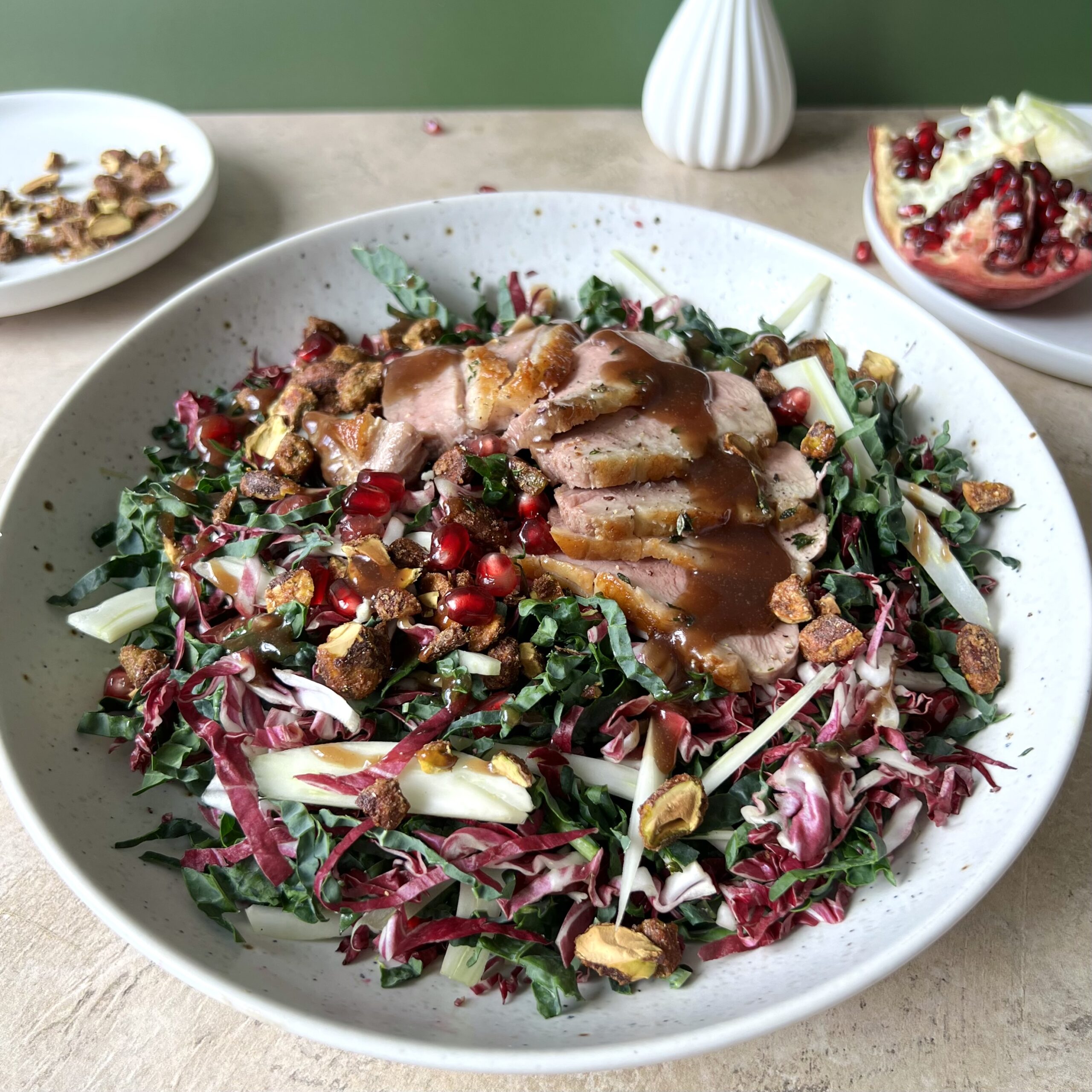
Crispy Duck Salad with Kale Fennel Candied Pistachios and Pomegranate Vinaigrette
fall salad, featured, gluten free, high protein salad, kale salad, lettuce free salad, med diet salad
Share this post:




File Under: How to Make a Sexy Duck Salad
Half a lifetime ago, I ate a duck salad at a bistro in Nolita that was so severely disappointing that I still think about it from time to time. The duck skin was flabby and it tasted vaguely like lighter fluid. My best guess is that the kitchen tried to crisp the skin quickly over high heat instead of giving the fat time to render slowly. Twenty-something year old me was too meek to speak to the manager, but today I wouldn’t hesitate. Anyone who works in food and beverage knows that there is really only one rule when preparing duck breast: the duck skin must be crispy.
How to Get Crispy Duck Skin
The most important thing you can do for crispy duck skin actually happens the day before you cook it. Salt the duck breasts and refrigerate them uncovered for 24 hours. This seasons the meat and, more importantly, gives the surface time to dry out. Right before cooking, score the skin in a crosshatch pattern. Don’t cut down into the meat; you’re simply creating channels for the fat to escape.
Then start the duck in a cold pan. This is not the moment to get impatient and crank up the heat. Place the duck skin-side down in a cold pan over medium-low heat and let the fat render gradually, about 10 to 12 minutes. Pour off the rendered fat as needed, leaving about 1 tablespoon in the pan. Once the skin is golden and most of the fat has rendered, add a garlic clove and some thyme. Then increase the heat to medium-high and let the skin get properly crisp.
Flip the duck and cook for another 1 to 3 minutes, until it reaches 130–135°F. Transfer it to a plate and let it rest skin-side up. Resting it skin-side up keeps the steam from softening that beautiful crisp skin you just worked so hard to create.
Make the Candied Pistachios
These are one of the elements that make this salad feel like something you might order at a restaurant, but they’re extremely easy to make at home.
Whisk together 1 egg white and 1 tablespoon water. Toss with 8 ounces raw pistachios, 5 tablespoons sugar, ½ teaspoon ground ginger, ¼ teaspoon ground clove, ½ teaspoon kosher salt, and black pepper.
Spread the pistachios onto a baking sheet and bake at 350°F for 35 minutes, stirring once. Let them cool before adding them to the salad. They’ll crisp up as they cool.
Make the Pomegranate Molasses Vinaigrette
This is a simple vinaigrette, but pomegranate molasses gives it a depth and tartness that you don’t get from vinegar alone.
To make it you’ll need:
- 3 tablespoons pomegranate molasses (here is my homemade recipe)
- 3 tablespoons balsamic vinegar
- 3 tablespoons red wine vinegar
- 1 teaspoon Dijon mustard
- 6 tablespoons olive oil
- 6 tablespoons neutral flavored oil, such as avocado oil
The Dijon helps emulsify the dressing while the pomegranate molasses brings sweetness and acidity. If you’ve never made your own pomegranate molasses, it’s worth keeping some around. It’s excellent in salad dressings and can also be used anywhere you might reach for a balsamic glaze.
Build the Salad
For the salad, you’ll need:
- 2 bunches lacinato kale
- 1 large head radicchio
- 2 small shaved fennel bulbs
- pomegranate arils (from one pomegranate)
- Candied pistachios
- Pomegranate molasses vinaigrette
And Don’t Toss the Duck Fat!
One of the best parts of cooking duck breast is the amount of fat it renders.
Strain it and save it in the refrigerator. Duck fat is fantastic for roasting potatoes, crisping vegetables, or doing pretty much anything that benefits from a little extra flavor and excellent browning. You went to all the trouble of rendering it. You might as well get a second meal out of it.
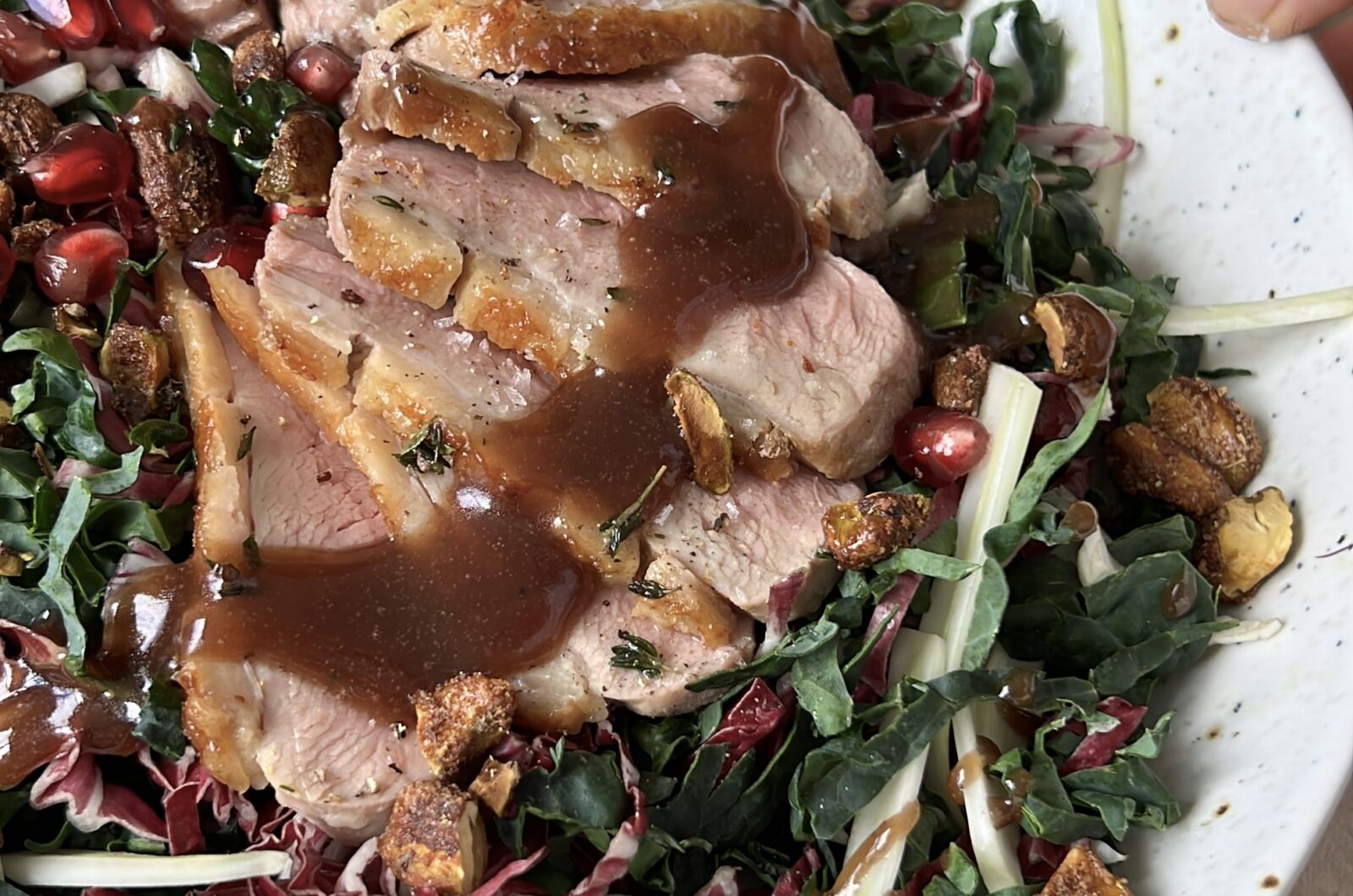
Crispy Duck Salad with Kale Fennel Candied Pistachios and Pomegranate Vinaigrette
Ingredients
Kosher salt
4 duck breasts (6-8 oz. each)
2 smashed garlic cloves
a few sprigs of thyme
2 bunches of lacinato kale, stems removed
1 large head of radicchio
2 small or 1 large fennel bulb
the arils of one pomegranate
black pepper
- Candied Pistachios
1 egg white
1 tbsp water
8 oz. raw pistachios
5 tbsp sugar
½ tsp ground ginger
¼ tsp ground clove
1/2 tsp Kosher salt
1/4 tsp ground black pepper
- Pomegranate Molasses Vinaigrette
3 tbsp pomegranate molasses (store bought or HOMEMADE)
3 tbsp balsamic vinegar
3 tbsp red wine vinegar
1 tsp Dijon mustard
2 clove of garlic
6 tbsp avocado oil
6 tbsp extra virgin olive oil
Kosher salt and black pepper
Directions
- Using appx. 1/2 tsp of Kosher salt for each duck breast, sprinkle salt over both sides of the duck breasts and refrigerate them uncovered for 24 hours. (I use a wire rack and a “1/4 size” sheet pan)
- Prepare the Candied Pistachios: Preheat the oven to 350° (F) and adjust the oven rack to the middle position. Combine the sugar, ground ginger, clove, kosher salt, and black pepper in a small bowl. Whisk the egg white with 1 tbsp water, then toss with the raw pistachios and spice blend. Pour pistachios onto a parchment paper lined sheet pan. Bake for 35 minutes, stirring once or twice during cook time. Allow to cool.
- Prep the Salad Ingredients: Thinly slice the kale and place in a large bowl. (To thinly slice the kale, roll it up like a little cigar and move your knife through it applying pressure with your non-knife hand. You want to make the knife cuts as close to another as possible.) Toss the kale ribbons with a small pinch of Kosher salt. Thinly slice the fennel using a mandolin slicer. Add to the bowl right on top of the kale. Thinly slice the radicchio and add to the bowl. Don’t toss all the greens together yet.
- Prepare the Pomegranate Vinaigrette: Place pomegranate molasses, red wine vinegar, balsamic vinegar, garlic and Dijon mustard in a quart sized mason jar or other similar sized receptacle. Using an immersion blender, blend until combined on low. While blending, slowly drizzle in the avocado oil and then the olive oil (increasing speed) to emulsify into the dressing. Season to taste with Kosher salt and black pepper.
- Blot the duck breasts dry with a paper towel. Score the duck breasts in a cross-hatched pattern just before cooking. Using a 12-inch sauté pan (or cook two breasts at a time if you only have a 10-inch pan) place the duck breasts skin-side down in a cold pan over medium-low heat for 10–12 minutes until golden, pouring off fat as needed, until 1 tbsp of fat remains in the pan. Add the garlic cloves and thyme. Crank the heat up to medium-high to crisp the skin, flip, and cook 1–3 minutes to 130–135°F. Rest skin-side up.
- Toss the kale, radicchio, fennel and pomegranate arils with appx. 4 tbsp of the vinaigrette. Divide the salad between 4 plates. Slice the duck breasts against the grain and serve over the salad. Garnish with candied pistachios and pass around more dressing.
Did you make this recipe?
Tag @thesaladwhisperer on Instagram and hashtag it with

Sarah Faris: The salad Whisperer
Sarah is a classically trained chef and Mom whose passion is spreading the gospel of salad. A native New Yorker, she now calls Miami, FL home.
Read more
Share this post:
Leave a Reply